
Snowy Commute or Muddy Trail? Picking the Right Grip for Your Next Used SUV
Lake-effect snow can turn a quick trip across Elkhart into a slow crawl, and a muddy two-track to your favorite fishing spot asks even more of an SUV. All-wheel drive and four-wheel drive both send power to every wheel, but they work in different ways and shine in different places. The right pick depends on where you drive, what you pull, and how often you leave the pavement.
- ✓AWD works in the background on its own and suits daily commutes, rain, and light snow.
- ✓4WD usually adds modes you choose yourself, and often a low range for deep snow, mud, trails, and heavy pulling.
- ✓For stopping and turning on snow and ice, good tires beat either system.
How All-Wheel Drive Handles Everyday Roads
All-wheel drive runs without any input from you. Some systems power all four wheels all the time. Others run mostly as front- or rear-wheel drive and shift power to the other axle the moment a tire starts to slip.
That hands-off setup suits crossovers like the Honda CR-V and Toyota RAV4. You get extra grip when pulling out of a slushy intersection, and the system is safe on dry pavement year-round. Most AWD systems skip low-range gearing, though, so they aren't built for deep ruts.
What Four-Wheel Drive Adds
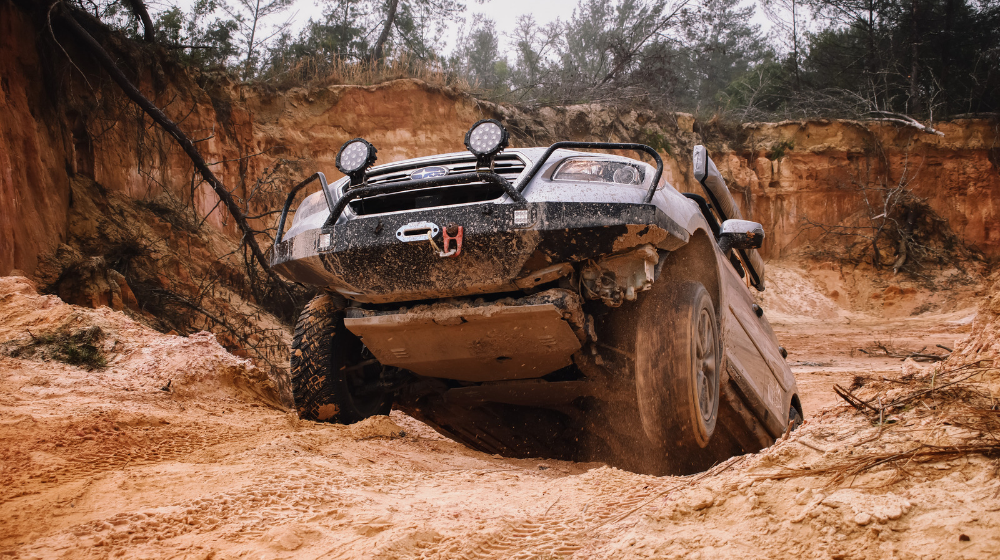
Four-wheel drive puts you in charge. A typical setup lets you pick 2-High, 4-High, or 4-Low with a dial or lever. That 4-Low setting adds extra gearing in the transfer case, so the SUV can creep up a rutted hill.
Many 4WD systems are part-time. They lack a center differential, so they belong in 2WD on dry pavement. Leaving them locked on dry roads can cause binding and extra wear. Full-time 4WD, found on some trims of the Toyota 4Runner, uses a center differential so it can stay engaged on any surface.
Browse used AWD and 4WD SUVs at S&H Auto Group.
AWD vs. 4WD in a Michiana Winter
Consumer Reports tested all-wheel drive on its snowy track and found it didn't help with braking or in certain corners. An AWD Honda CR-V on winter tires stopped from 60 mph in less than half the distance it needed on its original all-season tires.
So when you weigh AWD vs. 4WD for snowy months around South Bend and Mishawaka, think of either system as help for getting moving. An AWD crossover on good winter tires will handle most plowed roads. If you live down an unplowed county road or deal with deep drifts, the low range on a 4WD SUV starts to earn its keep.
Matching the System to Your Week
If most of your miles are on the Toll Road, US-20, or city streets, an AWD crossover fits right in. It's easy to park and never asks you to pick a mode.
Weekends tell a different story if you spend them hauling a camper to the state park, backing a boat down a gravel ramp, or checking deer stands on muddy farm lanes. That's 4WD country. Whichever system you pick, expect a small fuel penalty compared to a two-wheel-drive version of the same SUV.
What to Check on a Used AWD or 4WD SUV
Start with the tires. AWD and 4WD systems tie the wheels together, so Tire Rack recommends four tires that match in brand, design, and tread depth. Subaru calls for tread depths within about 2/32 inch of each other. A used SUV with one new tire and three worn ones deserves a closer look.
On a 4WD test drive, shift into 4-High and 4-Low the way the owner's manual says and watch for each dash light. In an AWD model, make a few slow, tight turns and listen for clunks. Ask for service records, too, since transfer cases and differentials have their own fluids.
Don't get hung up on badges. Brands name their systems in their own ways, and Ford calls the Explorer's system Intelligent 4WD. The better question is whether it has a low-range setting.
Choosing the Grip That Fits Your Life
For most drivers here, a well-kept AWD crossover with good tires covers winter commutes and weekend errands. If your plans include trails, deep snow, or a trailer on a slick ramp, a 4WD SUV with low range is worth the small hit at the pump. Picture the roughest drive you make often, then shop for the system that handles it.
AWD and 4WD Compared at a Glance
| Feature | All-Wheel Drive | Four-Wheel Drive |
|---|---|---|
| How power reaches the wheels | Works on its own. Some systems power all four wheels full-time, and others send power to the second axle when a tire starts to slip. | The driver picks the mode, usually 2-High, 4-High, or 4-Low. Some systems add an Auto setting. |
| Low-range gearing | Usually not offered. | Common. A two-speed transfer case adds 4-Low for crawling, climbing, and pulling at low speed. |
| Dry pavement | Safe to use on any surface, every day. | Part-time 4WD should stay in 2WD on dry pavement to avoid binding. Full-time 4WD has a center differential and can stay engaged. |
| Best fit | Daily commutes, rain, light snow, and gravel roads. | Deep snow, mud, trails, boat ramps, and rough two-tracks. |
| Winter stopping and steering | No help with braking. Winter tires make the biggest difference. | No help with braking. Winter tires make the biggest difference. |
| Fuel economy example | 2026 Honda CR-V 1.5L turbo: 29 mpg combined with AWD vs. 30 mpg with FWD. | 2026 Toyota 4Runner SR5 i-FORCE: 21 mpg combined with 4WD vs. 22 mpg with RWD. |
| Tire matching | Subaru calls for tread depths within about 2/32 inch. Audi allows up to 4/32 inch. | Tire Rack recommends matched brand, design, and tread depth on all four tires. |
| Familiar used SUV examples | Honda CR-V, Toyota RAV4 | Toyota 4Runner, Ford Bronco, Chevrolet Tahoe |
| Test-drive check | Make slow, tight turns in a parking lot and listen for clunks or shudders. | Shift into 4-High and 4-Low as the owner's manual directs and confirm each dash light. |
Fuel economy figures are EPA-estimated ratings for 2026 models as published by Honda and Toyota and listed on fueleconomy.gov. Older used model years may differ, so look up the exact year and trim on fueleconomy.gov. Tire tolerances come from manufacturer guidance reported by Tire Rack. Winter braking findings come from Consumer Reports testing.
Shop Used AWD and 4WD SUVs at S&H Auto Group
S&H Auto Group has been selling and servicing vehicles in Michiana since 2010, and we keep used SUVs at all three of our locations, from AWD crossovers made for the daily commute to 4WD models ready for muddy back roads. Our team will show you how each system works and line up back-to-back test drives so you can feel the difference. Every vehicle gets a careful inspection and comes with a vehicle history report, and our finance team works with good credit, less-than-perfect credit, and no credit at all. Once you're rolling, our service centers in Elkhart and Osceola can handle tire rotations and routine maintenance before winter hits.
AWD and 4WD Questions We Hear Often
Is AWD or 4WD better for snow?
Both help you get moving in the snow. AWD works on its own and suits plowed roads, while 4WD with low range handles deep snow and unplowed lanes better. Winter tires make the biggest difference for stopping and steering with either system.
Can I drive in 4WD on dry pavement?
Part-time 4WD systems should stay in 2WD on dry pavement because they lack a center differential, and running them locked can cause binding and wear. Full-time 4WD systems have a center differential and can stay engaged on any surface. Check the owner's manual for the SUV you're looking at.
Does AWD use more gas?
Usually a little. Honda rates the 2026 CR-V with the 1.5-liter turbo at 29 mpg combined with AWD and 30 mpg combined with front-wheel drive.
Do I need to replace all four tires on an AWD SUV?
Often, yes. Tire Rack recommends tires that match in brand, design, and tread depth on AWD and 4WD vehicles. Subaru calls for tread depths within about 2/32 inch of each other, so one new tire next to three worn ones can strain the system.